arXiv:2608.00976 ยท 2026

Location-Aware Fine-Grained
Representation Learning for Medical
Vision Foundation Models

A medical vision foundation model that yields clinically meaningful and spatially consistent patch-level representations, providing a stronger visual foundation for downstream medical LVLMs.

Myeongkyun Kang  ·  Yanting Yang  ·  Xiaoxiao Li†
The University of British Columbia, Vector Institute
The University of British Columbia logo Vector Institute logo
01 / Abstract

Fine-Grained Vision for Medical AI

Fine-grained visual representations are essential for medical image analysis, particularly when diagnostically relevant evidence is subtle and spatially localized. Modern transformer-based medical vision encoders must therefore learn patch-level representations that are both clinically meaningful and spatially consistent. Without these properties, large vision-language models (LVLMs) operate on an ambiguous visual foundation, limiting their ability to generate clinically reliable and spatially grounded responses.

However, existing training strategies for medical vision encoders rarely achieve both objectives. Image-text alignment provides clinically meaningful supervision primarily at the image level, leaving the spatial localization of diagnostic evidence weakly constrained. In contrast, self-supervised learning promotes spatial consistency but lacks the semantic supervision needed to distinguish visually similar yet clinically distinct regions.

To address this gap, we present LoFi, a medical vision foundation model built on location-aware fine-grained representation learning. LoFi trains a vision encoder with a lightweight large language model under grounding and grounded captioning objectives. Because these objectives require predicting location from clinical text and vice versa, spatial consistency emerges without any explicit patch-level regularization. To enable training at scale, we construct MedG, a large-scale medical grounding dataset of 4.48M image-text-box triplets curated from 84 datasets spanning 7 modalities. Across phrase grounding, visual question answering, and region-based organ classification under perturbations, LoFi consistently outperforms general-purpose and medical vision foundation models as well as state-of-the-art LVLMs.

4.48M
image-text-box triplets
1.37M
images
7
modalities
84
curated datasets
7
downstream datasets
6
baseline foundation models
02 / Motivation

Why Existing Encoders Fall Short

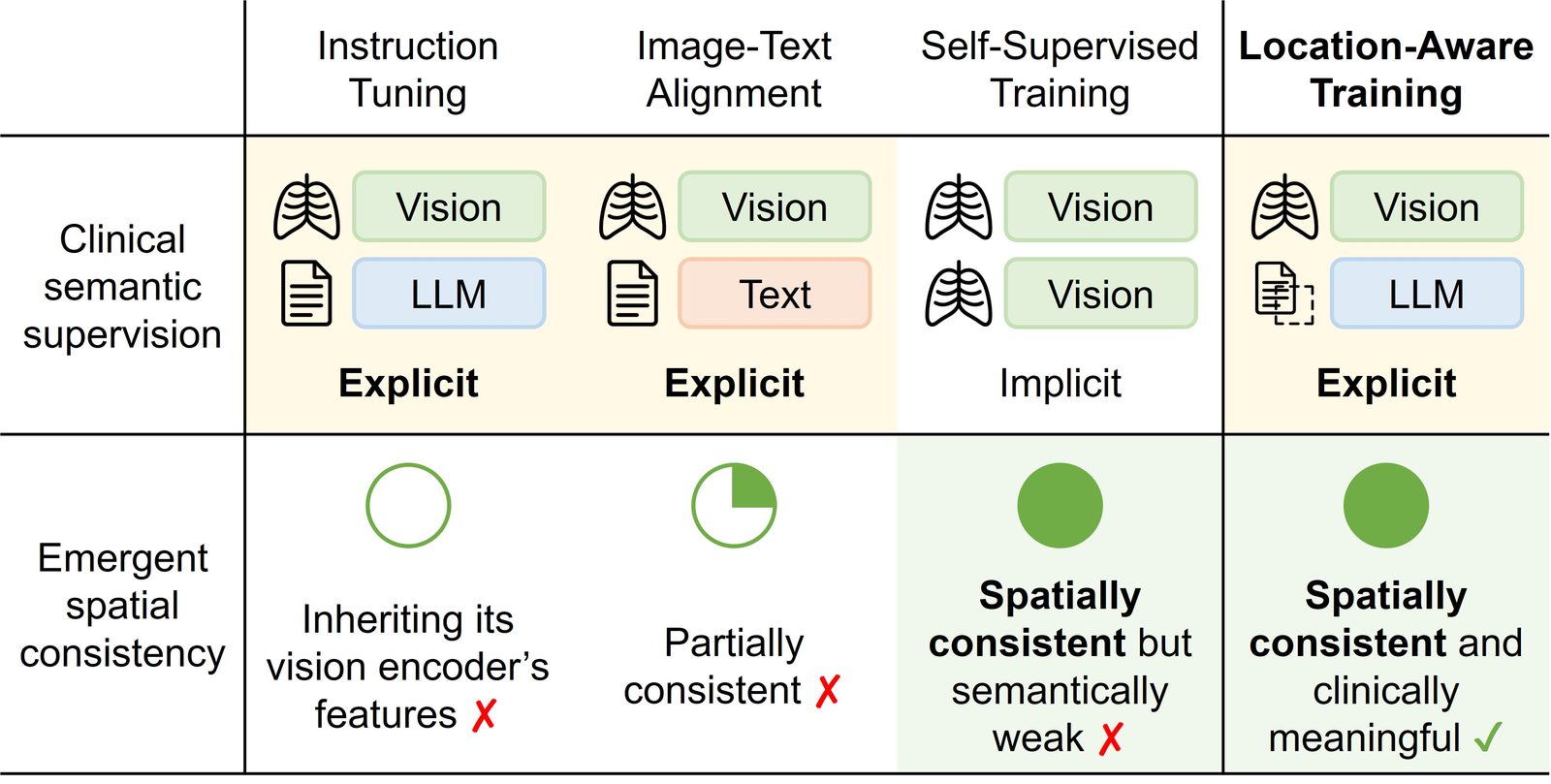
Reliable medical LVLMs require a vision encoder that yields fine-grained representation: patch-level features that are both clinically meaningful and spatially consistent. Current medical vision foundation models fall into three categories based on their training signal — instruction-tuned, image-text-aligned, and self-supervised — but none achieves both of these properties (Fig. 1).

Three categories of existing medical vision foundation models and LoFi
Figure 1. Encoders trained with explicit semantic supervision lack spatial consistency, whereas those relying on self-supervision are spatially consistent but semantically weak. Our location-aware training attains both.

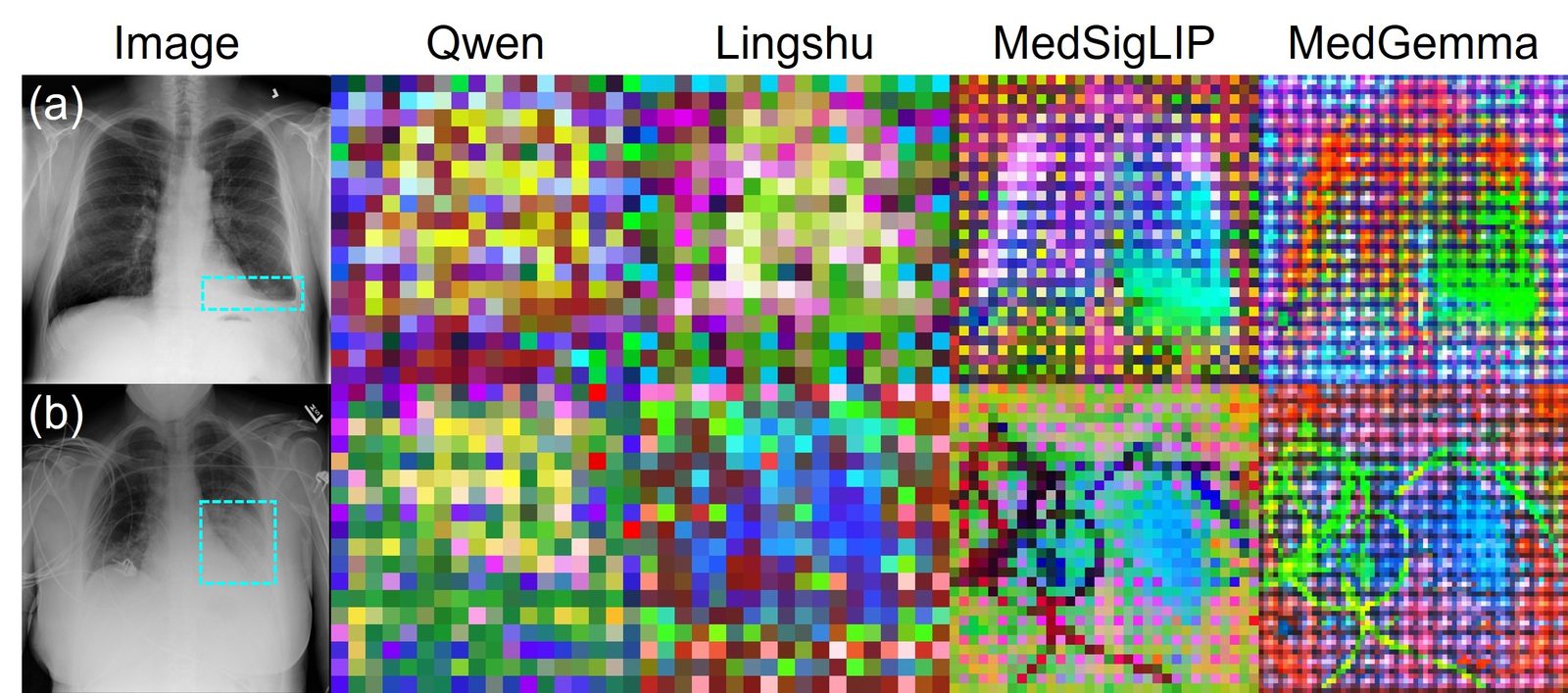
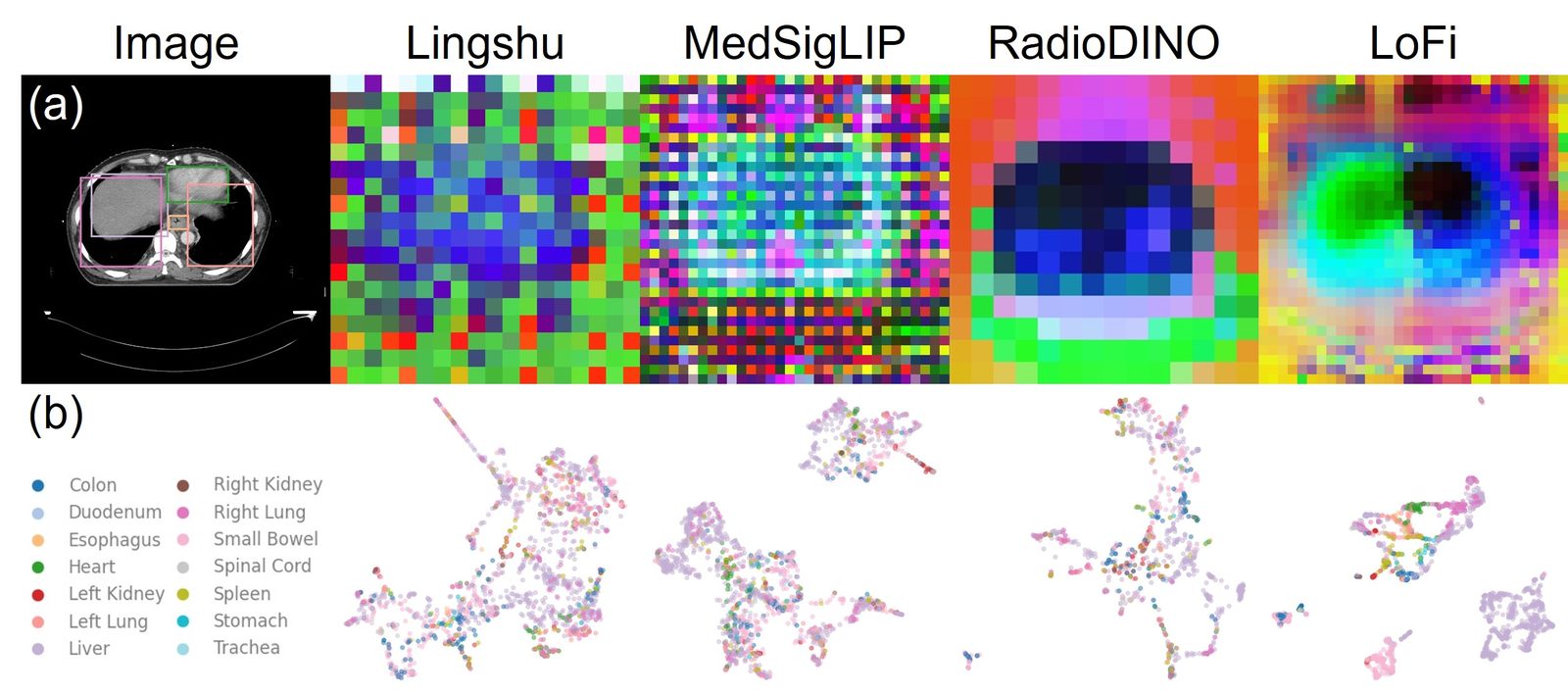
PCA maps and PaCMAP projections confirm this: the instruction-tuned Lingshu and the image-text-aligned MedSigLIP are spatially inconsistent, whereas the self-supervised RadioDINO is spatially consistent but cannot separate organs of similar intensity, such as the liver and heart (Figs. 2 and 3).

PCA maps of patch-level features from Qwen, Lingshu, MedSigLIP, and MedGemma
Figure 2. PCA maps of patch-level features from Qwen, Lingshu, MedSigLIP, and MedGemma. Instruction-tuned LVLMs inherit the patch-level properties of their vision encoders, and the emergent spatial consistency of image-text-aligned encoders remains insufficient.
PCA maps and PaCMAP projections of patch-level features from Lingshu, MedSigLIP, RadioDINO, and LoFi
Figure 3. PCA maps and PaCMAP projections from Lingshu, MedSigLIP, RadioDINO, and LoFi (ours). Lingshu and MedSigLIP mirror their noisy PCA maps, whereas RadioDINO fails to separate organs. LoFi alone yields features that are both spatially consistent and clinically meaningful.
03 / Method

The LoFi Framework

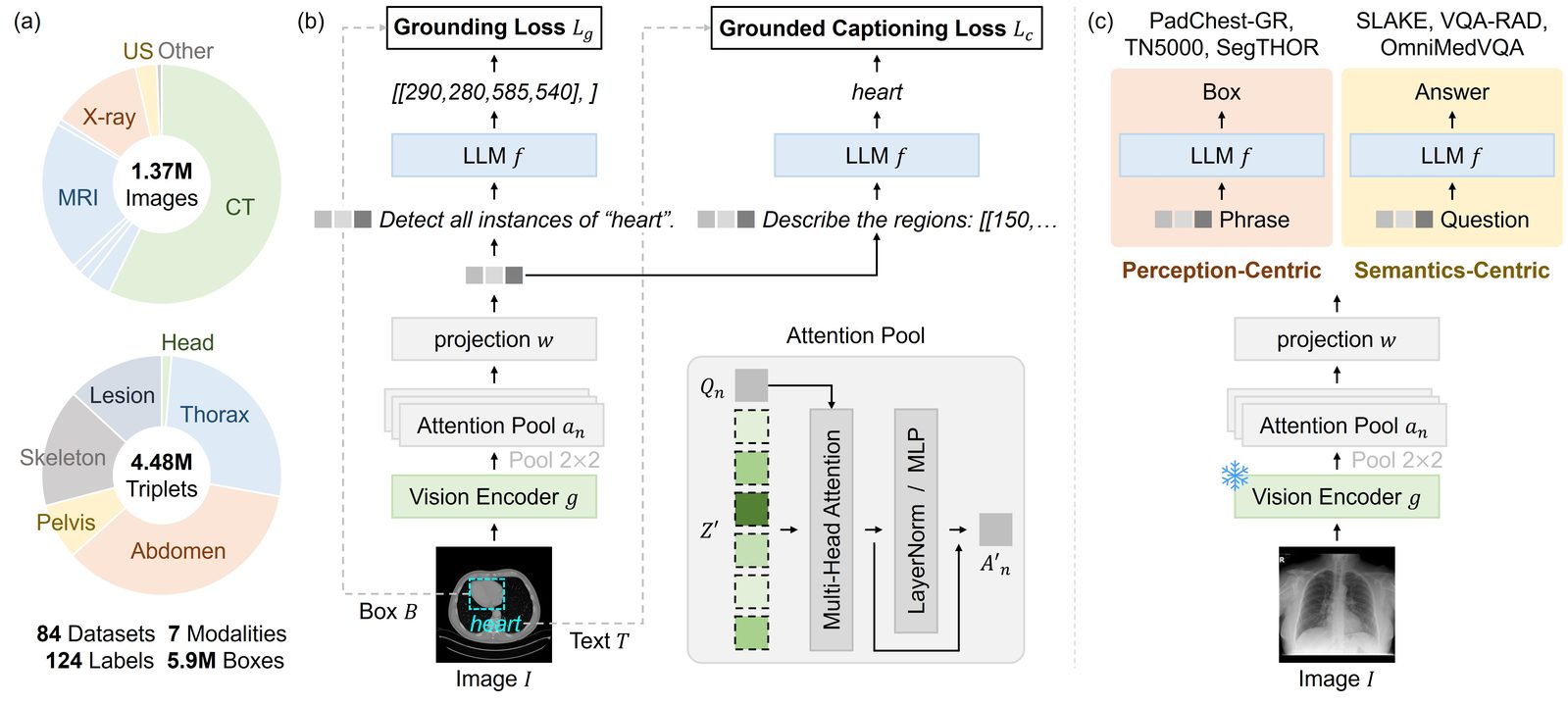
We construct MedG, a large-scale medical grounding dataset of 4.48M image-text-box triplets curated from 84 datasets across 7 modalities. We propose LoFi, trained with a grounding loss that predicts bounding boxes from clinical text and a grounded captioning loss that reverses this — letting spatially consistent, clinically meaningful features emerge jointly without any explicit patch-level constraint (Fig. 4).

Overview of the location-aware fine-grained representation learning framework
Figure 4. Overview of the location-aware fine-grained representation learning framework. (a) The MedG dataset. (b) LoFi training on image-text-box triplets. (c) Fine-tuning of the vision encoder for perception-centric and semantics-centric tasks.
04 / Results

Experiments on Downstream Datasets

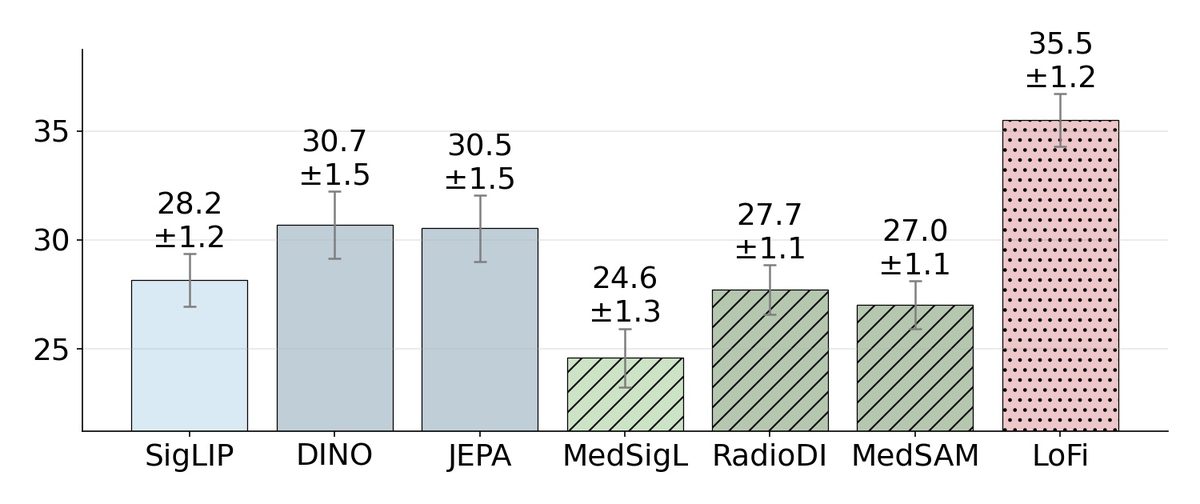
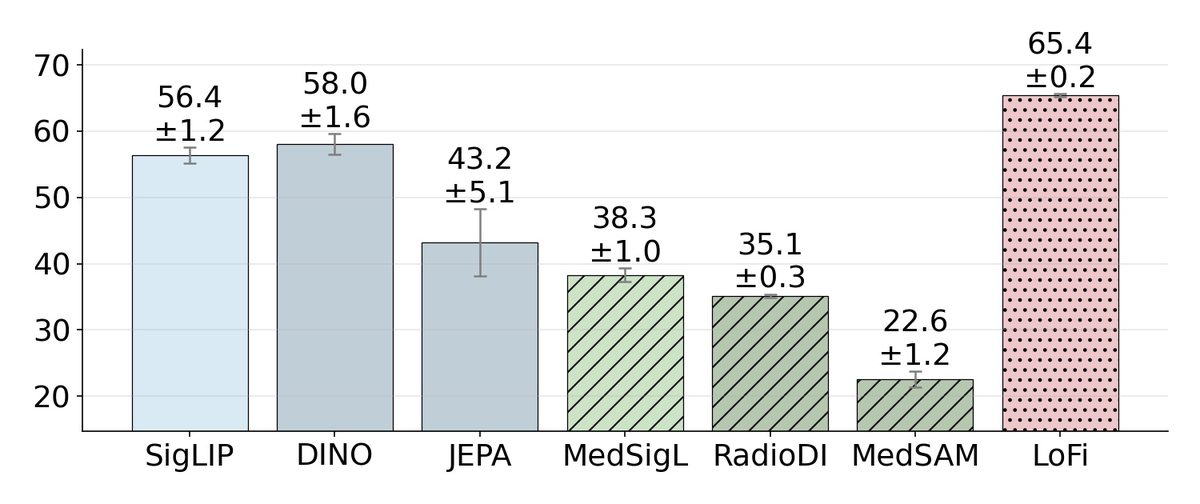
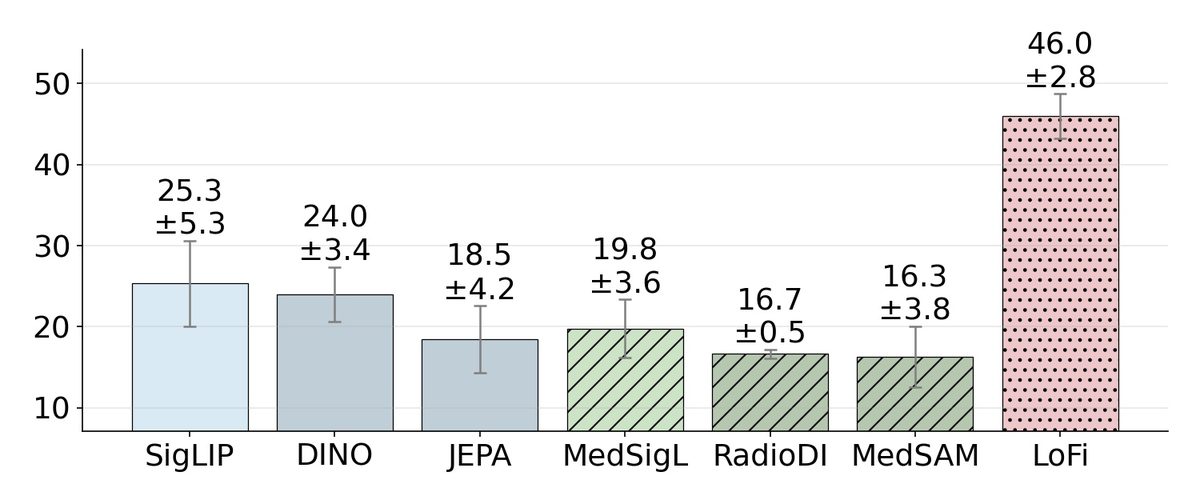
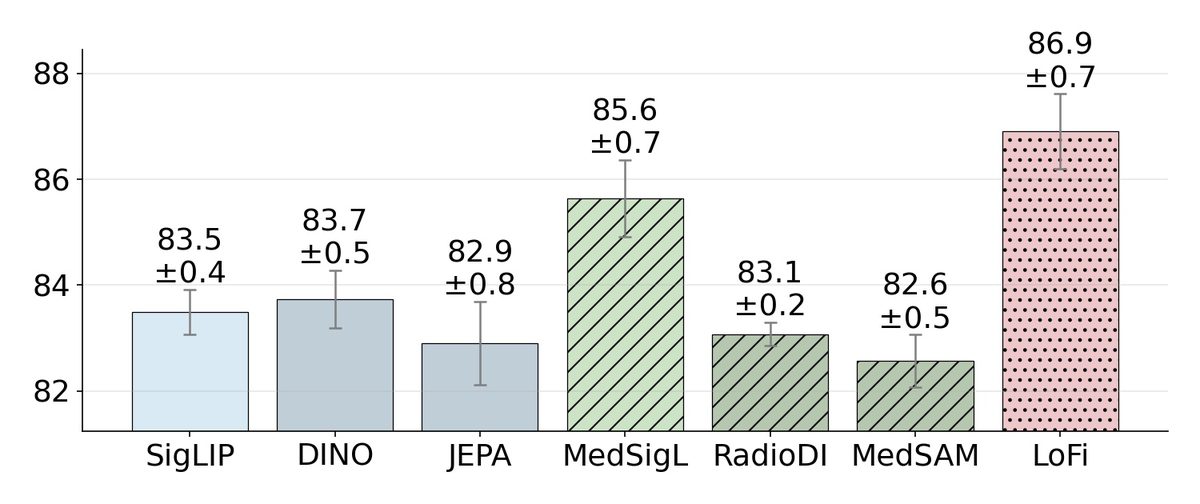
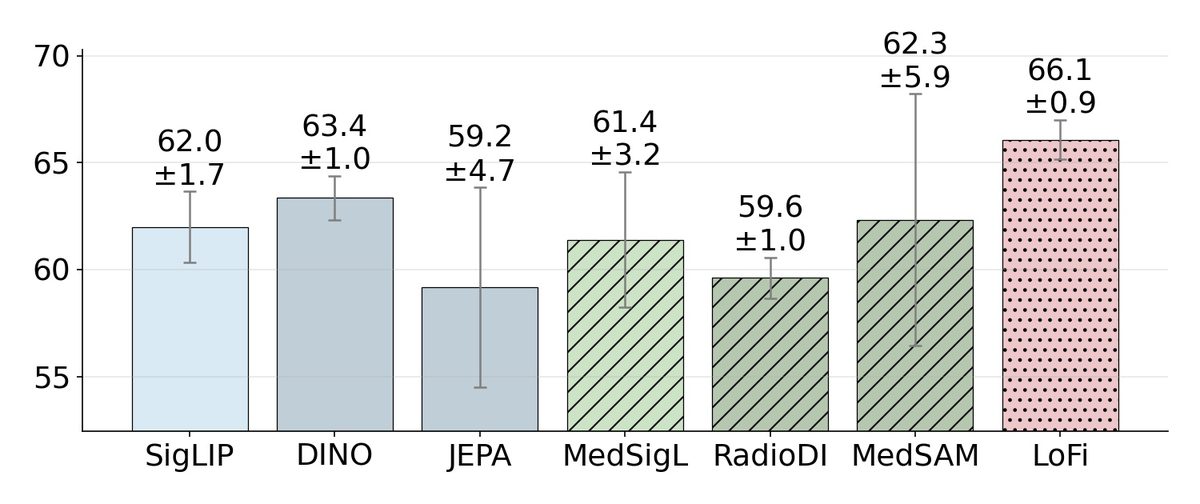
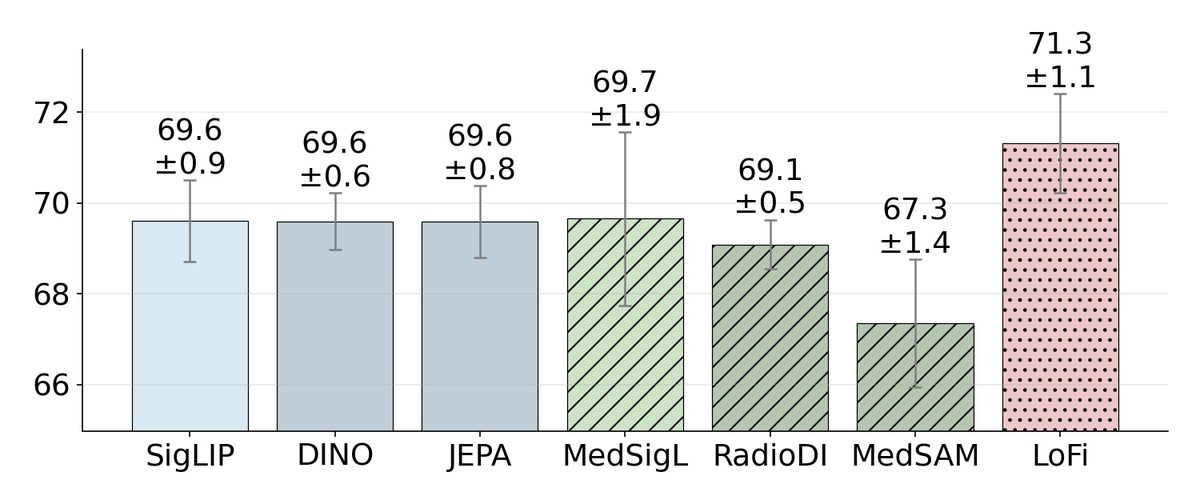
LoFi outperforms all prior models across every downstream dataset (Fig. 5). On perception-centric datasets, models with strong spatial consistency (e.g., DINO) perform best among prior work; on semantics-centric SLAKE, models with explicit image-text alignment (e.g., MedSigLIP) score highest. LoFi attains both properties, which explains its consistent gains across dataset types.

PadChest-GR results
(a) PadChest-GR
TN5000 results
(b) TN5000
SegTHOR results
(c) SegTHOR
SLAKE results
(d) SLAKE
VQA-RAD results
(e) VQA-RAD
OmniMedVQA results
(f) OmniMedVQA
Figure 5. Fine-tuning results on perception-centric (a)–(c) and semantics-centric (d)–(f) datasets. LoFi (red) outperforms general-purpose (blue) and medical (green) foundation models.

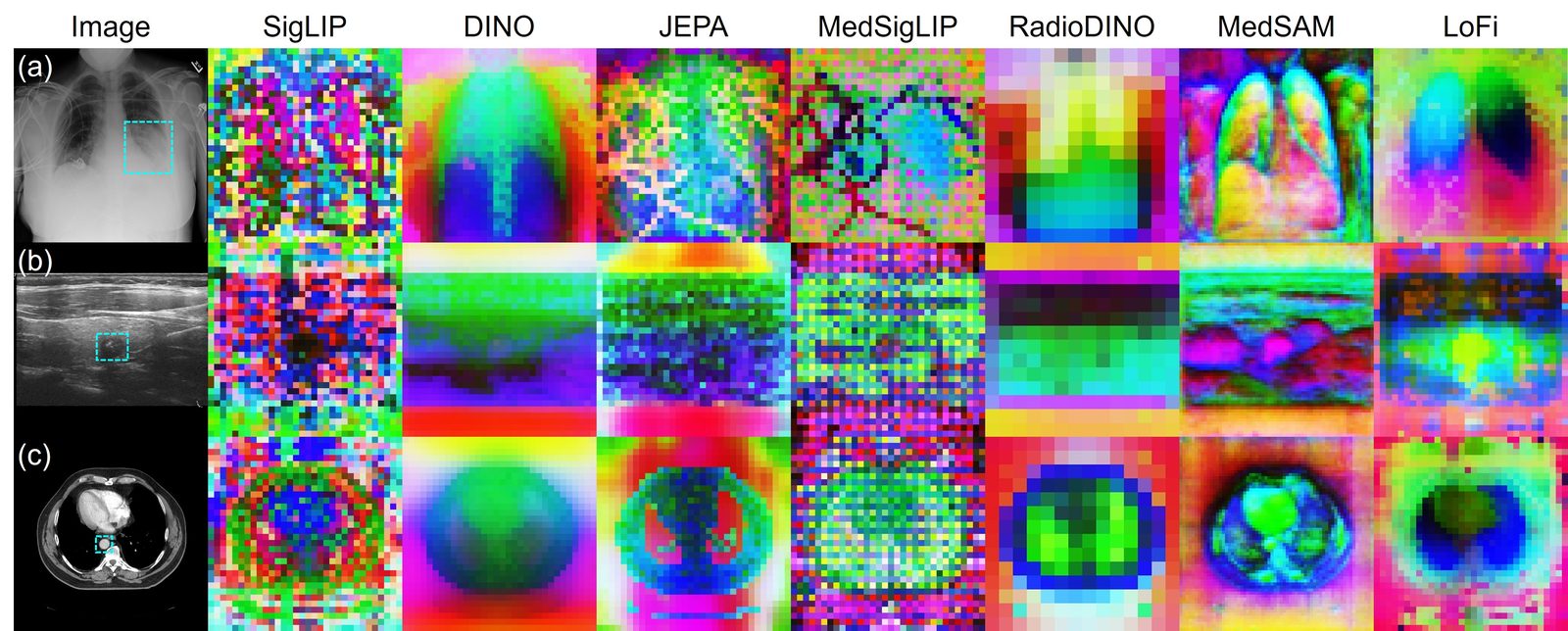
LoFi's patch-level features are highly consistent within anatomical structures and effectively separate small targets from surrounding structures (Fig. 6).

PCA maps of patch-level features from SigLIP, DINO, JEPA, MedSigLIP, RadioDINO, MedSAM, and LoFi
Figure 6. PCA maps of patch-level features from SigLIP, DINO, JEPA, MedSigLIP, RadioDINO, MedSAM, and LoFi (ours) on a chest X-ray, ultrasound image, and CT slice.

Full quantitative results and ablations are in the paper.

05 / Citation

Cite This Work

If you find LoFi useful, please consider citing:

@article{kang2026location,
  title   = {Location-Aware Fine-Grained Representation Learning for Medical Vision Foundation Models},
  author  = {Kang, Myeongkyun and Yang, Yanting and Li, Xiaoxiao},
  journal = {International Conference on Medical Image Computing and Computer-Assisted Intervention},
  year    = {2026}
}
06 / Acknowledgments

This research is supported, in part, by the NSERC Discovery Grant, NSERC Alliance Grant, and a Canada Research Chair Fellowship (Tri-Agency Canada); Canada CIFAR AI Chair Awards; Genome British Columbia, the Terry Fox Research Institute, and Health Research BC; Google Gemini Research Awards; the IITP grant funded by the Korea government (MSIT); and the NRF grant funded by the Korea government (MSIT).